Artist Bio
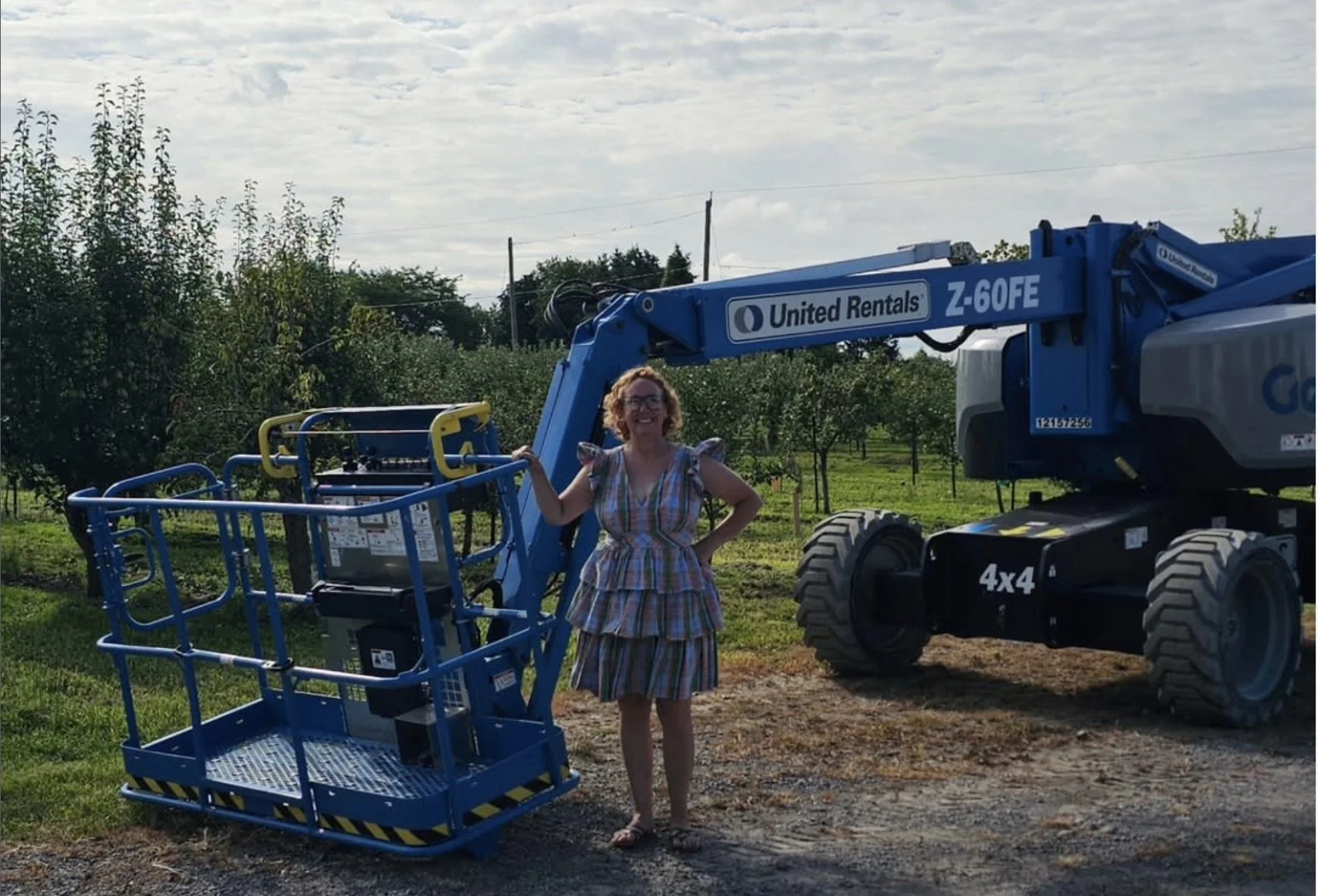
Carrie Perreault (she/her) is a multidisciplinary artist based in Niagara and Toronto/Tkaronto, working across sculpture, installation, printmaking, performance, collaborative publishing, and community-engaged art. Her recent projects include We Must Love and Support One Another, an ongoing public artwork developed with residents of Toronto’s Weston neighbourhood; Between Fields, a collaborative textile exchange connecting migrant agricultural workers in Niagara with makers in Rajasthan, India; and The Secret Life of Machines, a large-scale performance project that reimagines articulating boom lifts as performers.
Perreault holds an MFA from the University of Waterloo. Her work has been exhibited at Gallery Stratford, the University of Waterloo Art Gallery, Niagara Artists Centre, and The Artist Project, where she was invited to present an installation of nearly 300 sculptures in 2024. She received the Toronto Outdoor Art Fair’s Best of Art Fair Award in 2021. Her 2019 publication period of adjustment featured essays by art critic and writer Lucy R. Lippard and curator and writer Sky Goodden. Her work has received support from the Canada Council for the Arts, Ontario Arts Council, Toronto Arts Council, and Social Sciences and Humanities Research Council.
Perreault’s community involvement extends beyond her studio practice. She co-founded a tenant union in her York South–Weston apartment building, which successfully negotiated up to eight months of rent relief for neighbours during the COVID-19 pandemic. She also served with the University of Waterloo Graduate Student Association as Fine Arts Councillor and as a member of its Executive Graduate Student Relations Committee.
Artist Statement
Carrie Perreault’s practice begins with a curiosity about the things we live alongside but do not always pay attention to: ordinary objects, tools, repetitive movements, infrastructure, materials, and the traces people leave behind. Working across sculpture, installation, printmaking, performance, and collaborative practice, she is interested in how memory, labour, care, and vulnerability become embedded in the material world.
Rooted in a feminist approach to autotheory, Perreault’s earlier work examined personal histories, childhood trauma, and memories that resist certainty. Repetition, accumulation, and the multiple became important ways of working—making something again and again could be meditative, while also giving physical form to experiences that were difficult to articulate.
These concerns continue to underpin her practice, but the scale of her attention has increasingly shifted outward. Perreault is interested in what happens between people, places, objects, and systems, and in forms of knowledge that come through doing: operating a machine, working the land, carving a block, or making something alongside another person. Collaboration and sustained engagement with people and place often become part of the material of the work itself.
Perreault’s seasonal work on her family farm in Niagara has sharpened her attention to labour, tools, repetition, movement, and material knowledge. Across her practice, she considers what can happen when we spend more time with something we might otherwise overlook—and what it can reveal about how we care for, depend upon, and live alongside one another.